
A new year is a perfect opportunity to reflect on our top 10 surgeries last year at HRVSS.
1. ACL surgery
There is no question, year after year, that ACL surgery is #1 in our practice.
We offer 3 main surgery options, depending on the patient (cat, small dog, big dog) and very importantly, an angle at the top of the shin bone (the “tibial plateau angle”).
Everything depends on that angle, it is much more important than we used to think.
Ignoring it can lead to poor results.
Let’s try to simplify things.
- In small patients with a small angle, we can use heavy nylon sutures to “replace” the torn ACL.
- In larger patients or patients with a steep angle, we recommend a TPLO, which allows us to flatten that angle. This is by far our #1 procedure at HRVSS.
- In patients with a very steep angle, the best option is a TWO (Tibial Wedge Osteotomy) or a CWO (Cranial Wedge Osteotomy).
When the correct surgery is performed in the correct patient, we typically get good to excellent results.
2. Tumor removal
We remove an impressive number of tumors, either benign or malignant (cancerous).
The most common ones are on, in or below the skin.
But they can live anywhere: in the gum or jaw, in the nose, in the neck (e.g. thyroid cancer), in the lung, in the liver, in the spleen, in the kidney, in the bladder, in the intestine, in the anus, in the anal sac (frequently!)… and so many more!
3. Broken bones
We have repaired fractures in virtually every bone: the jaw, the front leg, the pelvis, and the back leg.
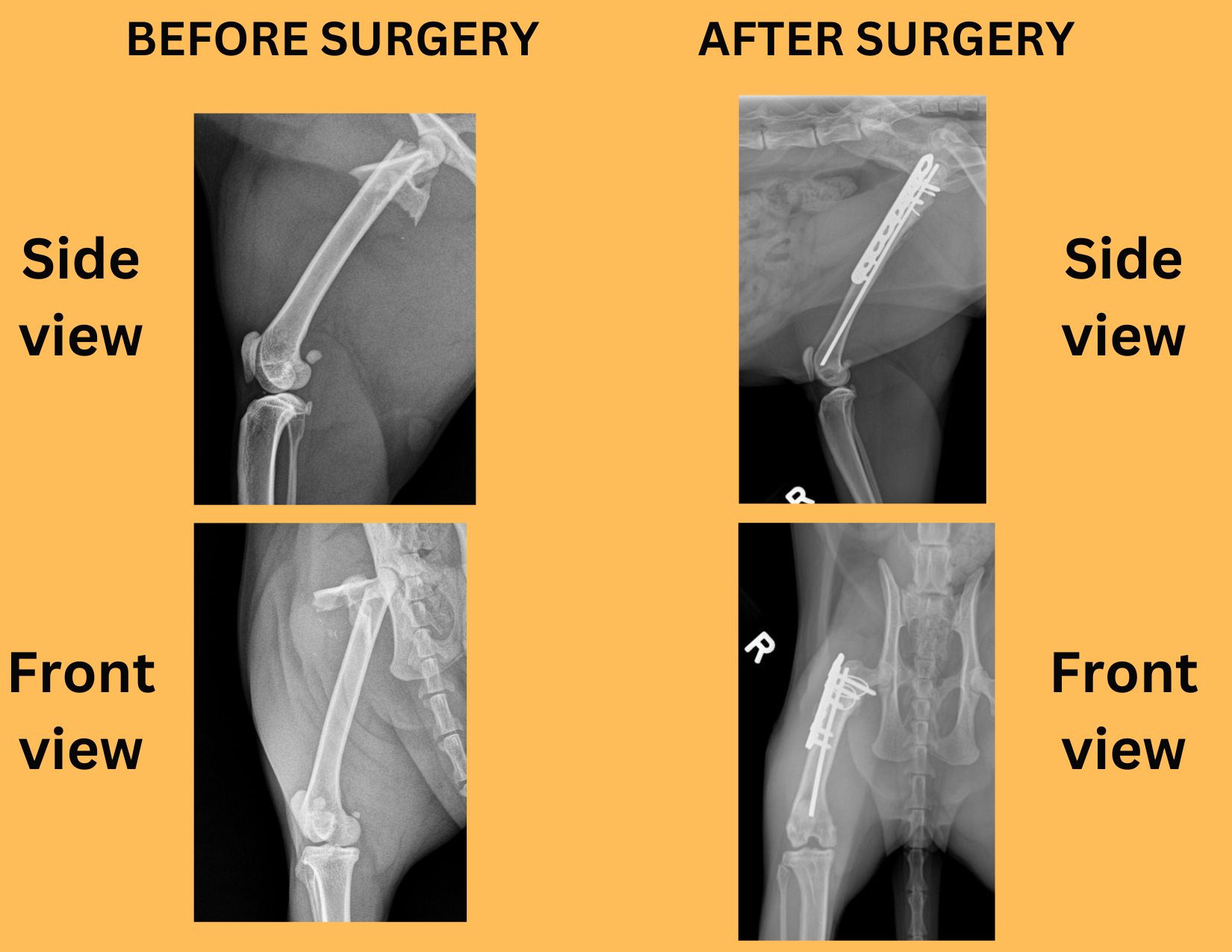
Some fractures require a pin, most need a plate and screws.
This is an example of a complex fracture of the thigh bone (femur) that was repaired by Dr. Pete Baia with a pin, a plate and some screws.
4. Kneecap dislocations
Kneecap dislocations are another incredibly common surgery at HRVSS, mostly in dogs, and also in cats.
They can happen alone, or with a torn ACL, which changes the surgery a bit.
The sooner these patients get surgery to keep the kneecap where it belongs, the less arthritis they get, so time is of the essence.
5. Nose jobs (BOAS)
Do you know the #1 breed in the US?
It is not the Lab anymore.
It’s the Frenchie – the French bulldog.
Like most Bulldogs and dogs (and cats) with a flat face (brachycephalic breeds), they go through life struggling to breathe, unable to exercise, panting for no good reasons, and snoring when they sleep.
None of those are normal.
These dogs suffer.
Yet we can perform surgery to help these patients breathe dramatically better.
There are 3 main steps to address BOAS (Brachycephalic Obstructive Airway Syndrome):
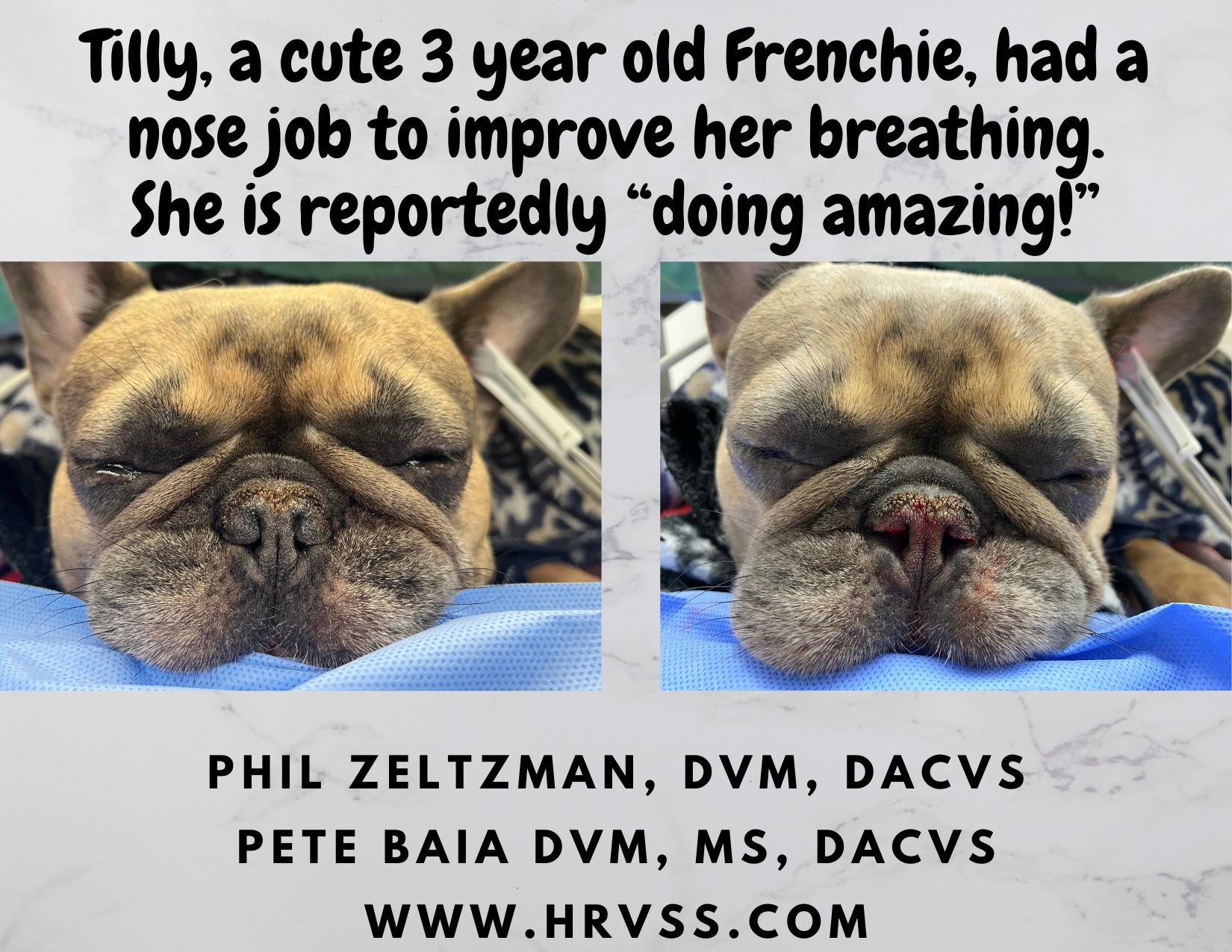
- Step 1: The only visible surgery is the “nose job,” designed to widen the nostrils (see before and after pictures below).
- Step 2: One or two additional surgeries are performed inside the mouth (to shorten their elongated soft palate and…
- Step 3: … if needed, remove 2 fleshy parts in the throat (everted laryngeal saccules).
6. Hopeless ear infections
Another type of patient who often suffers, quietly and unnoticed, is a patient with ongoing ear infections.
Beyond a certain point, no amount of medication or antibiotic will fix the problem.
The only option is a surgery called a TECA (Total Ear Canal Ablation).
In good hands, it can dramatically improve the patient’s quality of life.
We also performed a number of TECAs to remove a tumor in the ear canal.
7. Hip surgery
The main hip surgery we perform is the FHO (Femoral Head Ostectomy), aka removal of the “ball” of the hip, to address 4 mains reasons:
- hip dysplasia or hip arthritis
- a hip fracture
- a hip dislocation
- or deterioration of the “ball” of the hip (Legg Perthes disease).
Intensive physical therapy is critical to achieve a good range of motion after an FHO.
8. Belly surgery
Last year, we performed belly surgery to remove all kinds of tumors (see above), remove all kinds of body parts (spleen, kidney, part of the intestine, adrenal glands, etc), take biopsies, and remove bladder stones.
9. Laryngeal paralysis
Laryngeal paralysis (paralysis of the larynx or voice box) is a serious condition that causes suffocation.
The surgery (“a tie back”) uses heavy nylon sutures to open up the airway and help these poor dogs breathe.
Most patients quickly go from suffocating to being able to breathe comfortably.
10. Joint injections for arthritis
This was the biggest surprise of the year.
As our knowledge has improved, we have treated a number of cats and dogs with arthritis by injecting their painful joints with a variety of medications:
- long-acting cortisone
- “HA” (hyaluronic acid), a natural lubricant in the joint
- Spryng, a natural product mostly made of collagen.
We can combine those drugs and product depending on the patient’s needs.
This little year-end exercise is very interesting to us. It helps us look at what we do all day.
Here’s to a wonderful & healthy New Year to you, your family and your pets.
If you would like to learn how we can help your pet with safe surgery and anesthesia, please contact us through www.HRVSS.com
Never miss a blog by subscribing here: www.HRVSS.com/blog
Phil Zeltzman, DVM, DACVS, CVJ, Fear Free Certified
Pete Baia, DVM, MS, DACVS
www.HRVSS.com